注意
点击 这里 下载完整示例代码
训练一个玩马里奥的强化学习智能体
创建日期: 2020年12月17日 | 最后更新日期: 2024年2月5日 | 最后验证: 未验证
作者: 冯源松, 苏拉杰·苏布拉马尼亚姆, 霍华德·王, 史蒂文·郭。
本教程将引导您了解深度强化学习的基础知识。最后,您将实现一个由人工智能驱动的马里奥(使用 双深度Q网络), 它可以自行玩游戏。
虽然本教程不需要任何强化学习(RL)的先验知识,但您可以熟悉这些RL 概念, 并随身携带这份 速查表 作为您的助手。完整代码可在 此处 获取。
%%bash
pip install gym-super-mario-bros==7.4.0
pip install tensordict==0.3.0
pip install torchrl==0.3.0
import torch
from torch import nn
from torchvision import transforms as T
from PIL import Image
import numpy as np
from pathlib import Path
from collections import deque
import random, datetime, os

# Gym is an OpenAI toolkit for RL
import gym
from gym.spaces import Box
from gym.wrappers import FrameStack

# NES Emulator for OpenAI Gym
from nes_py.wrappers import JoypadSpace

# Super Mario environment for OpenAI Gym
import gym_super_mario_bros

from tensordict import TensorDict
from torchrl.data import TensorDictReplayBuffer, LazyMemmapStorage
强化学习定义
环境 代理交互和学习的世界。
动作 \(a\):智能体对环境的响应方式。所有可能的动作集合称为 动作空间。
状态 \(s\):环境的当前特征。环境可以处于的所有可能状态的集合称为 状态空间。
奖励 \(r\) : 奖励是环境向智能体反馈的关键信息。它驱动智能体学习并改变其未来的行动。多个时间步的奖励总和被称为回报。
最优动作-价值函数 \(Q^*(s,a)\):给出了如果你从状态 \(s\) 开始,采取任意动作 \(a\),并在每个未来的步骤中采取最大化回报的动作时的预期回报。可以认为 \(Q\) 代表了在某个状态下动作的“质量”。我们试图近似这个函数。
环境
初始化环境
在马里奥游戏中,环境由管道、蘑菇和其他组件构成。
当马里奥执行一个动作时,环境会以改变后的(下一个)状态、奖励和其他信息作为回应。
# Initialize Super Mario environment (in v0.26 change render mode to 'human' to see results on the screen)
if gym.__version__ < '0.26':
    env = gym_super_mario_bros.make("SuperMarioBros-1-1-v0", new_step_api=True)
else:
    env = gym_super_mario_bros.make("SuperMarioBros-1-1-v0", render_mode='rgb', apply_api_compatibility=True)

# Limit the action-space to
#   0. walk right
#   1. jump right
env = JoypadSpace(env, [["right"], ["right", "A"]])

env.reset()
next_state, reward, done, trunc, info = env.step(action=0)
print(f"{next_state.shape},\n {reward},\n {done},\n {info}")
/usr/local/lib/python3.10/dist-packages/gym/envs/registration.py:555: UserWarning:

WARN: The environment SuperMarioBros-1-1-v0 is out of date. You should consider upgrading to version `v3`.

/usr/local/lib/python3.10/dist-packages/gym/envs/registration.py:627: UserWarning:

WARN: The environment creator metadata doesn't include `render_modes`, contains: ['render.modes', 'video.frames_per_second']

/usr/local/lib/python3.10/dist-packages/gym/utils/passive_env_checker.py:233: DeprecationWarning:

`np.bool8` is a deprecated alias for `np.bool_`.  (Deprecated NumPy 1.24)

(240, 256, 3),
 0.0,
 False,
 {'coins': 0, 'flag_get': False, 'life': 2, 'score': 0, 'stage': 1, 'status': 'small', 'time': 400, 'world': 1, 'x_pos': 40, 'y_pos': 79}
预处理环境
环境数据在 next_state 返回给代理。如您所见,每个状态由一个 [3, 240, 256] 大小的数组表示。
通常这比我们的代理需要的信息多;例如,马里奥的动作并不依赖于管道或天空的颜色!
我们使用包装器来预处理环境数据,然后再将其发送给代理。
GrayScaleObservation 是一个常见的包装器,用于将RGB图像转换为灰度图像;这样做可以减少状态表示的大小而不丢失有用的信息。现在每个状态的大小:
[1, 240, 256]
ResizeObservation 将每个观测值下采样为一个正方形图像。
新尺寸: [1, 84, 84]
SkipFrame 是一个自定义包装器,继承自 gym.Wrapper 并实现了 step() 函数。由于连续帧之间的变化不大,我们可以在不丢失太多信息的情况下跳过 n 个中间帧。第 n 帧会聚合每个跳过的帧中累积的奖励。
FrameStack 是一个包装器,允许我们将环境中的连续帧压缩成单个观察点以供我们的学习模型使用。这样,我们可以通过Mario在前几帧中的移动方向来识别他是在着陆还是跳跃。
class SkipFrame(gym.Wrapper):
    def __init__(self, env, skip):
        """Return only every `skip`-th frame"""
        super().__init__(env)
        self._skip = skip

    def step(self, action):
        """Repeat action, and sum reward"""
        total_reward = 0.0
        for i in range(self._skip):
            # Accumulate reward and repeat the same action
            obs, reward, done, trunk, info = self.env.step(action)
            total_reward += reward
            if done:
                break
        return obs, total_reward, done, trunk, info


class GrayScaleObservation(gym.ObservationWrapper):
    def __init__(self, env):
        super().__init__(env)
        obs_shape = self.observation_space.shape[:2]
        self.observation_space = Box(low=0, high=255, shape=obs_shape, dtype=np.uint8)

    def permute_orientation(self, observation):
        # permute [H, W, C] array to [C, H, W] tensor
        observation = np.transpose(observation, (2, 0, 1))
        observation = torch.tensor(observation.copy(), dtype=torch.float)
        return observation

    def observation(self, observation):
        observation = self.permute_orientation(observation)
        transform = T.Grayscale()
        observation = transform(observation)
        return observation


class ResizeObservation(gym.ObservationWrapper):
    def __init__(self, env, shape):
        super().__init__(env)
        if isinstance(shape, int):
            self.shape = (shape, shape)
        else:
            self.shape = tuple(shape)

        obs_shape = self.shape + self.observation_space.shape[2:]
        self.observation_space = Box(low=0, high=255, shape=obs_shape, dtype=np.uint8)

    def observation(self, observation):
        transforms = T.Compose(
            [T.Resize(self.shape, antialias=True), T.Normalize(0, 255)]
        )
        observation = transforms(observation).squeeze(0)
        return observation


# Apply Wrappers to environment
env = SkipFrame(env, skip=4)
env = GrayScaleObservation(env)
env = ResizeObservation(env, shape=84)
if gym.__version__ < '0.26':
    env = FrameStack(env, num_stack=4, new_step_api=True)
else:
    env = FrameStack(env, num_stack=4)
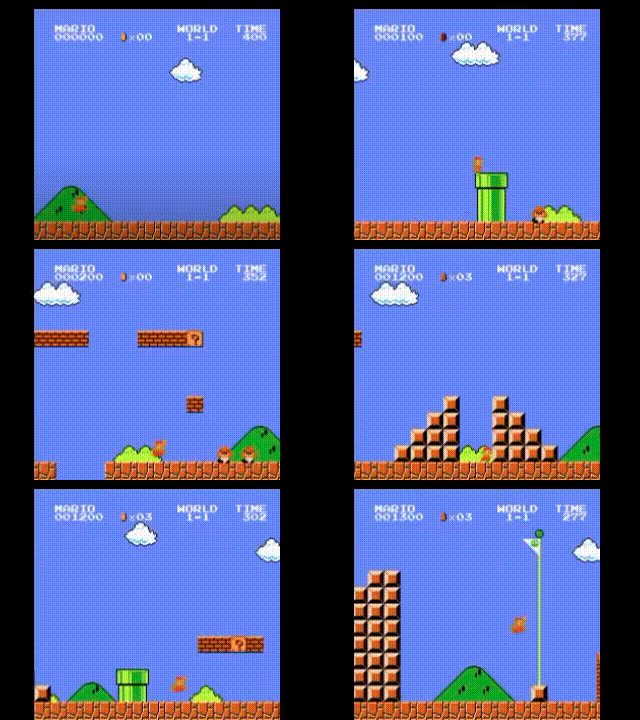
在将上述包装器应用到环境后,最终的包装状态由4个灰度连续帧堆叠在一起组成,如左图所示。每次马里奥执行一个动作时,环境都会以这种结构的状态进行响应。该结构由大小为[4, 84, 84]的3D数组表示。

代理
我们创建一个类 Mario 来表示游戏中的代理。马里奥应该能够:
根据当前环境状态,按照最优行动策略行动。
记住经验。经验 = (当前状态,当前动作,奖励,下一个状态)。马里奥 缓存 并在之后 回忆 他的经验以更新他的动作策略。
学习随着时间推移更好的行动策略
class Mario:
    def __init__():
        pass

    def act(self, state):
        """Given a state, choose an epsilon-greedy action"""
        pass

    def cache(self, experience):
        """Add the experience to memory"""
        pass

    def recall(self):
        """Sample experiences from memory"""
        pass

    def learn(self):
        """Update online action value (Q) function with a batch of experiences"""
        pass
在接下来的部分中,我们将填充马里奥的参数并定义他的函数。
激活
对于任何给定的状态,代理可以选择执行最优动作(利用)或随机动作(探索)。
马里奥有 self.exploration_rate 的概率随机探索;当他选择利用时,他依赖于 MarioNet(在 Learn 部分中实现)来提供最优行动。
class Mario:
    def __init__(self, state_dim, action_dim, save_dir):
        self.state_dim = state_dim
        self.action_dim = action_dim
        self.save_dir = save_dir

        self.device = "cuda" if torch.cuda.is_available() else "cpu"

        # Mario's DNN to predict the most optimal action - we implement this in the Learn section
        self.net = MarioNet(self.state_dim, self.action_dim).float()
        self.net = self.net.to(device=self.device)

        self.exploration_rate = 1
        self.exploration_rate_decay = 0.99999975
        self.exploration_rate_min = 0.1
        self.curr_step = 0

        self.save_every = 5e5  # no. of experiences between saving Mario Net

    def act(self, state):
        """
    Given a state, choose an epsilon-greedy action and update value of step.

    Inputs:
    state(``LazyFrame``): A single observation of the current state, dimension is (state_dim)
    Outputs:
    ``action_idx`` (``int``): An integer representing which action Mario will perform
    """
        # EXPLORE
        if np.random.rand() < self.exploration_rate:
            action_idx = np.random.randint(self.action_dim)

        # EXPLOIT
        else:
            state = state[0].__array__() if isinstance(state, tuple) else state.__array__()
            state = torch.tensor(state, device=self.device).unsqueeze(0)
            action_values = self.net(state, model="online")
            action_idx = torch.argmax(action_values, axis=1).item()

        # decrease exploration_rate
        self.exploration_rate *= self.exploration_rate_decay
        self.exploration_rate = max(self.exploration_rate_min, self.exploration_rate)

        # increment step
        self.curr_step += 1
        return action_idx
缓存和召回
这两个函数充当马里奥的“记忆”过程。
cache(): 每次马里奥执行一个动作时,他都会将
experience 存储到他的记忆中。他的经验包括当前的
状态、执行的动作、从动作中获得的奖励、下一个状态,
以及游戏是否结束。
recall(): 马里奥从他的记忆中随机抽取一批经验,并用这些经验来学习游戏。
class Mario(Mario):  # subclassing for continuity
    def __init__(self, state_dim, action_dim, save_dir):
        super().__init__(state_dim, action_dim, save_dir)
        self.memory = TensorDictReplayBuffer(storage=LazyMemmapStorage(100000, device=torch.device("cpu")))
        self.batch_size = 32

    def cache(self, state, next_state, action, reward, done):
        """
        Store the experience to self.memory (replay buffer)

        Inputs:
        state (``LazyFrame``),
        next_state (``LazyFrame``),
        action (``int``),
        reward (``float``),
        done(``bool``))
        """
        def first_if_tuple(x):
            return x[0] if isinstance(x, tuple) else x
        state = first_if_tuple(state).__array__()
        next_state = first_if_tuple(next_state).__array__()

        state = torch.tensor(state)
        next_state = torch.tensor(next_state)
        action = torch.tensor([action])
        reward = torch.tensor([reward])
        done = torch.tensor([done])

        # self.memory.append((state, next_state, action, reward, done,))
        self.memory.add(TensorDict({"state": state, "next_state": next_state, "action": action, "reward": reward, "done": done}, batch_size=[]))

    def recall(self):
        """
        Retrieve a batch of experiences from memory
        """
        batch = self.memory.sample(self.batch_size).to(self.device)
        state, next_state, action, reward, done = (batch.get(key) for key in ("state", "next_state", "action", "reward", "done"))
        return state, next_state, action.squeeze(), reward.squeeze(), done.squeeze()
学习
Mario 使用了 DDQN 算法 作为其底层实现。DDQN 使用两个卷积神经网络 - \(Q_{online}\) 和 \(Q_{target}\) - 来独立地逼近最优动作价值函数。
在我们的实现中,我们在\(Q_{online}\)和\(Q_{target}\)之间共享特征生成器features, 但为每个分类器保留独立的全连接(FC)分类器。(\(Q_{target}\)的参数)被冻结以防止通过反向传播进行更新。相反,它会定期与\(\theta_{online}\)同步(稍后会详细介绍)。
神经网络
class MarioNet(nn.Module):
    """mini CNN structure
  input -> (conv2d + relu) x 3 -> flatten -> (dense + relu) x 2 -> output
  """

    def __init__(self, input_dim, output_dim):
        super().__init__()
        c, h, w = input_dim

        if h != 84:
            raise ValueError(f"Expecting input height: 84, got: {h}")
        if w != 84:
            raise ValueError(f"Expecting input width: 84, got: {w}")

        self.online = self.__build_cnn(c, output_dim)

        self.target = self.__build_cnn(c, output_dim)
        self.target.load_state_dict(self.online.state_dict())

        # Q_target parameters are frozen.
        for p in self.target.parameters():
            p.requires_grad = False

    def forward(self, input, model):
        if model == "online":
            return self.online(input)
        elif model == "target":
            return self.target(input)

    def __build_cnn(self, c, output_dim):
        return nn.Sequential(
            nn.Conv2d(in_channels=c, out_channels=32, kernel_size=8, stride=4),
            nn.ReLU(),
            nn.Conv2d(in_channels=32, out_channels=64, kernel_size=4, stride=2),
            nn.ReLU(),
            nn.Conv2d(in_channels=64, out_channels=64, kernel_size=3, stride=1),
            nn.ReLU(),
            nn.Flatten(),
            nn.Linear(3136, 512),
            nn.ReLU(),
            nn.Linear(512, output_dim),
        )
TD 估计与 TD 目标
学习过程中涉及两个值:
TD估计 - 给定状态下预测的最优 \(Q^*\) \(s\)
TD目标 - 当前奖励和下一个状态估计值\(Q^*\)的聚合,下一个状态为\(s'\)
由于我们不知道下一步动作 \(a'\) 会是什么,因此我们使用在下一个状态 \(s'\) 中最大化 \(Q_{online}\) 的动作 \(a'\)。
请注意,我们在 td_target() 上使用了
@torch.no_grad()
装饰器来禁用这里的梯度计算
(因为我们不需要对 \(\theta_{target}\) 进行反向传播)。
class Mario(Mario):
    def __init__(self, state_dim, action_dim, save_dir):
        super().__init__(state_dim, action_dim, save_dir)
        self.gamma = 0.9

    def td_estimate(self, state, action):
        current_Q = self.net(state, model="online")[
            np.arange(0, self.batch_size), action
        ]  # Q_online(s,a)
        return current_Q

    @torch.no_grad()
    def td_target(self, reward, next_state, done):
        next_state_Q = self.net(next_state, model="online")
        best_action = torch.argmax(next_state_Q, axis=1)
        next_Q = self.net(next_state, model="target")[
            np.arange(0, self.batch_size), best_action
        ]
        return (reward + (1 - done.float()) * self.gamma * next_Q).float()
更新模型
当马里奥从他的回放缓冲区中采样输入时,我们计算 \(TD_t\)
和 \(TD_e\) 并将此损失反向传播到 \(Q_{online}\),
以更新其参数 \(\theta_{online}\)(\(\alpha\) 是传递给
lr 的学习率 optimizer)
\(\theta_{target}\) 不通过反向传播进行更新。 相反,我们定期将 \(\theta_{online}\) 复制到 \(\theta_{target}\)
class Mario(Mario):
    def __init__(self, state_dim, action_dim, save_dir):
        super().__init__(state_dim, action_dim, save_dir)
        self.optimizer = torch.optim.Adam(self.net.parameters(), lr=0.00025)
        self.loss_fn = torch.nn.SmoothL1Loss()

    def update_Q_online(self, td_estimate, td_target):
        loss = self.loss_fn(td_estimate, td_target)
        self.optimizer.zero_grad()
        loss.backward()
        self.optimizer.step()
        return loss.item()

    def sync_Q_target(self):
        self.net.target.load_state_dict(self.net.online.state_dict())
保存检查点
class Mario(Mario):
    def save(self):
        save_path = (
            self.save_dir / f"mario_net_{int(self.curr_step // self.save_every)}.chkpt"
        )
        torch.save(
            dict(model=self.net.state_dict(), exploration_rate=self.exploration_rate),
            save_path,
        )
        print(f"MarioNet saved to {save_path} at step {self.curr_step}")
整合所有内容
class Mario(Mario):
    def __init__(self, state_dim, action_dim, save_dir):
        super().__init__(state_dim, action_dim, save_dir)
        self.burnin = 1e4  # min. experiences before training
        self.learn_every = 3  # no. of experiences between updates to Q_online
        self.sync_every = 1e4  # no. of experiences between Q_target & Q_online sync

    def learn(self):
        if self.curr_step % self.sync_every == 0:
            self.sync_Q_target()

        if self.curr_step % self.save_every == 0:
            self.save()

        if self.curr_step < self.burnin:
            return None, None

        if self.curr_step % self.learn_every != 0:
            return None, None

        # Sample from memory
        state, next_state, action, reward, done = self.recall()

        # Get TD Estimate
        td_est = self.td_estimate(state, action)

        # Get TD Target
        td_tgt = self.td_target(reward, next_state, done)

        # Backpropagate loss through Q_online
        loss = self.update_Q_online(td_est, td_tgt)

        return (td_est.mean().item(), loss)
日志记录
import numpy as np
import time, datetime
import matplotlib.pyplot as plt


class MetricLogger:
    def __init__(self, save_dir):
        self.save_log = save_dir / "log"
        with open(self.save_log, "w") as f:
            f.write(
                f"{'Episode':>8}{'Step':>8}{'Epsilon':>10}{'MeanReward':>15}"
                f"{'MeanLength':>15}{'MeanLoss':>15}{'MeanQValue':>15}"
                f"{'TimeDelta':>15}{'Time':>20}\n"
            )
        self.ep_rewards_plot = save_dir / "reward_plot.jpg"
        self.ep_lengths_plot = save_dir / "length_plot.jpg"
        self.ep_avg_losses_plot = save_dir / "loss_plot.jpg"
        self.ep_avg_qs_plot = save_dir / "q_plot.jpg"

        # History metrics
        self.ep_rewards = []
        self.ep_lengths = []
        self.ep_avg_losses = []
        self.ep_avg_qs = []

        # Moving averages, added for every call to record()
        self.moving_avg_ep_rewards = []
        self.moving_avg_ep_lengths = []
        self.moving_avg_ep_avg_losses = []
        self.moving_avg_ep_avg_qs = []

        # Current episode metric
        self.init_episode()

        # Timing
        self.record_time = time.time()

    def log_step(self, reward, loss, q):
        self.curr_ep_reward += reward
        self.curr_ep_length += 1
        if loss:
            self.curr_ep_loss += loss
            self.curr_ep_q += q
            self.curr_ep_loss_length += 1

    def log_episode(self):
        "Mark end of episode"
        self.ep_rewards.append(self.curr_ep_reward)
        self.ep_lengths.append(self.curr_ep_length)
        if self.curr_ep_loss_length == 0:
            ep_avg_loss = 0
            ep_avg_q = 0
        else:
            ep_avg_loss = np.round(self.curr_ep_loss / self.curr_ep_loss_length, 5)
            ep_avg_q = np.round(self.curr_ep_q / self.curr_ep_loss_length, 5)
        self.ep_avg_losses.append(ep_avg_loss)
        self.ep_avg_qs.append(ep_avg_q)

        self.init_episode()

    def init_episode(self):
        self.curr_ep_reward = 0.0
        self.curr_ep_length = 0
        self.curr_ep_loss = 0.0
        self.curr_ep_q = 0.0
        self.curr_ep_loss_length = 0

    def record(self, episode, epsilon, step):
        mean_ep_reward = np.round(np.mean(self.ep_rewards[-100:]), 3)
        mean_ep_length = np.round(np.mean(self.ep_lengths[-100:]), 3)
        mean_ep_loss = np.round(np.mean(self.ep_avg_losses[-100:]), 3)
        mean_ep_q = np.round(np.mean(self.ep_avg_qs[-100:]), 3)
        self.moving_avg_ep_rewards.append(mean_ep_reward)
        self.moving_avg_ep_lengths.append(mean_ep_length)
        self.moving_avg_ep_avg_losses.append(mean_ep_loss)
        self.moving_avg_ep_avg_qs.append(mean_ep_q)

        last_record_time = self.record_time
        self.record_time = time.time()
        time_since_last_record = np.round(self.record_time - last_record_time, 3)

        print(
            f"Episode {episode} - "
            f"Step {step} - "
            f"Epsilon {epsilon} - "
            f"Mean Reward {mean_ep_reward} - "
            f"Mean Length {mean_ep_length} - "
            f"Mean Loss {mean_ep_loss} - "
            f"Mean Q Value {mean_ep_q} - "
            f"Time Delta {time_since_last_record} - "
            f"Time {datetime.datetime.now().strftime('%Y-%m-%dT%H:%M:%S')}"
        )

        with open(self.save_log, "a") as f:
            f.write(
                f"{episode:8d}{step:8d}{epsilon:10.3f}"
                f"{mean_ep_reward:15.3f}{mean_ep_length:15.3f}{mean_ep_loss:15.3f}{mean_ep_q:15.3f}"
                f"{time_since_last_record:15.3f}"
                f"{datetime.datetime.now().strftime('%Y-%m-%dT%H:%M:%S'):>20}\n"
            )

        for metric in ["ep_lengths", "ep_avg_losses", "ep_avg_qs", "ep_rewards"]:
            plt.clf()
            plt.plot(getattr(self, f"moving_avg_{metric}"), label=f"moving_avg_{metric}")
            plt.legend()
            plt.savefig(getattr(self, f"{metric}_plot"))
让我们一起玩吧!
在这个例子中,我们运行了40个训练周期,但为了让马里奥真正学会他世界的规则,我们建议至少运行40,000个周期!
use_cuda = torch.cuda.is_available()
print(f"Using CUDA: {use_cuda}")
print()

save_dir = Path("checkpoints") / datetime.datetime.now().strftime("%Y-%m-%dT%H-%M-%S")
save_dir.mkdir(parents=True)

mario = Mario(state_dim=(4, 84, 84), action_dim=env.action_space.n, save_dir=save_dir)

logger = MetricLogger(save_dir)

episodes = 40
for e in range(episodes):

    state = env.reset()

    # Play the game!
    while True:

        # Run agent on the state
        action = mario.act(state)

        # Agent performs action
        next_state, reward, done, trunc, info = env.step(action)

        # Remember
        mario.cache(state, next_state, action, reward, done)

        # Learn
        q, loss = mario.learn()

        # Logging
        logger.log_step(reward, loss, q)

        # Update state
        state = next_state

        # Check if end of game
        if done or info["flag_get"]:
            break

    logger.log_episode()

    if (e % 20 == 0) or (e == episodes - 1):
        logger.record(episode=e, epsilon=mario.exploration_rate, step=mario.curr_step)

Using CUDA: True

Episode 0 - Step 163 - Epsilon 0.9999592508251706 - Mean Reward 635.0 - Mean Length 163.0 - Mean Loss 0.0 - Mean Q Value 0.0 - Time Delta 1.958 - Time 2025-01-02T22:15:50
Episode 20 - Step 5007 - Epsilon 0.9987490329557962 - Mean Reward 667.429 - Mean Length 238.429 - Mean Loss 0.0 - Mean Q Value 0.0 - Time Delta 56.842 - Time 2025-01-02T22:16:47
Episode 39 - Step 8854 - Epsilon 0.9977889477081997 - Mean Reward 656.6 - Mean Length 221.35 - Mean Loss 0.0 - Mean Q Value 0.0 - Time Delta 45.301 - Time 2025-01-02T22:17:32
结论
在本教程中,我们看到了如何使用 PyTorch 训练一个玩游戏的人工智能。你可以使用相同的方法来训练一个人工智能玩 OpenAI gym 中的任何游戏。希望你喜欢这个教程,欢迎随时通过我们的 GitHub 联系我们!
脚本的总运行时间:(1分45.054秒)